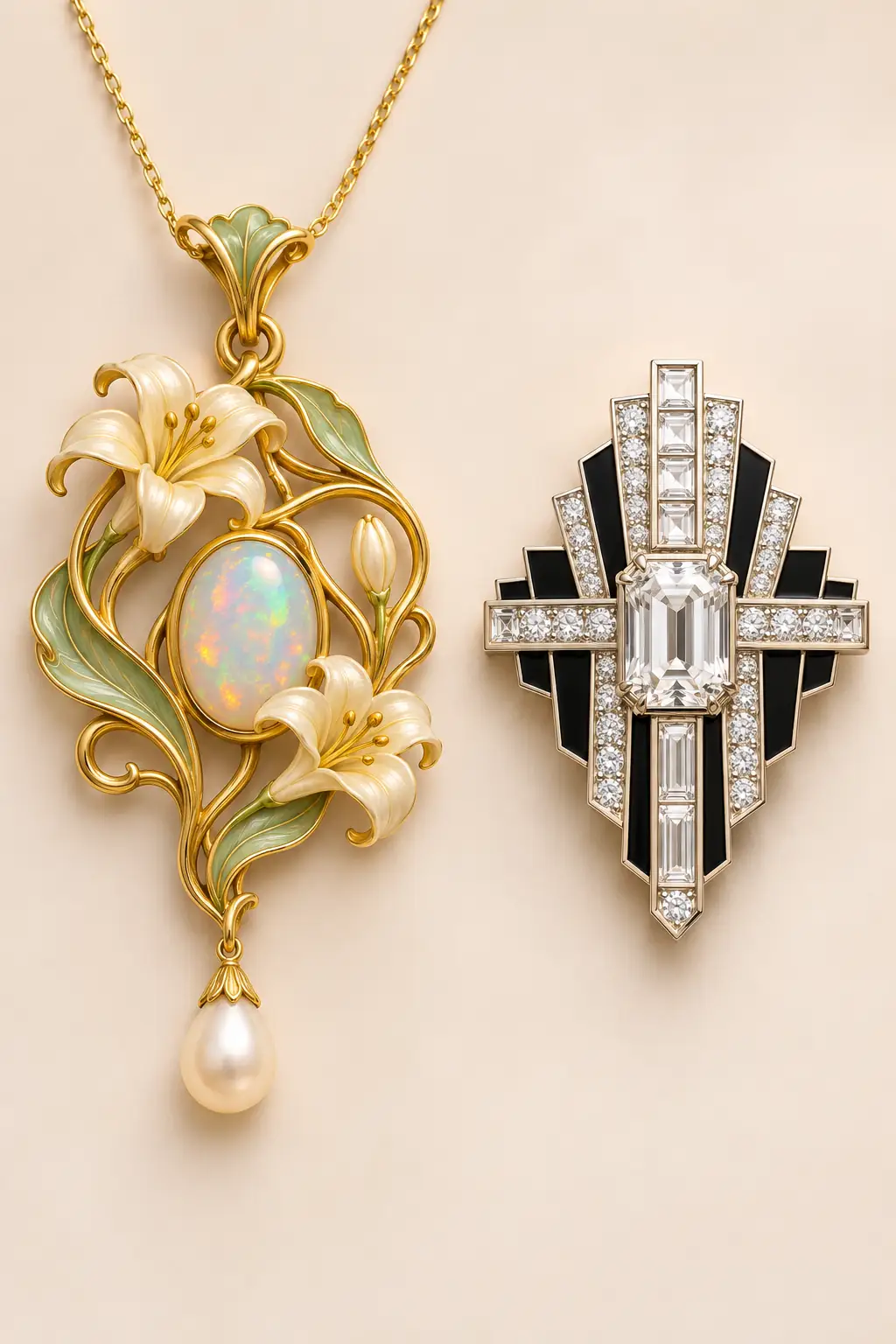
Hold two brooches side by side. One curls around the shape of an orchid; the other is built from steps, straight lines and a disciplined fan. It is tempting to call the first Art Nouveau and the second Art Deco, then decide they were made a generation apart. The first part might be a useful description of style. The second is a claim about age, and it takes more evidence. The best way to read these designs is to notice what they do with a line, a material and a motif before looking for a date.
1. First, follow the outline with your eye
Art Nouveau jewellery often behaves as though it is growing. A stem bends into a brooch pin, a wing changes into the edge of a pendant, and a flower can be stretched into an unfamiliar shape. The outline might be uneven, with one side answering the other rather than matching it. The Victoria and Albert Museum describes Art Nouveau jewellers as moving towards sinuous, organic designs around the turn of the twentieth century.
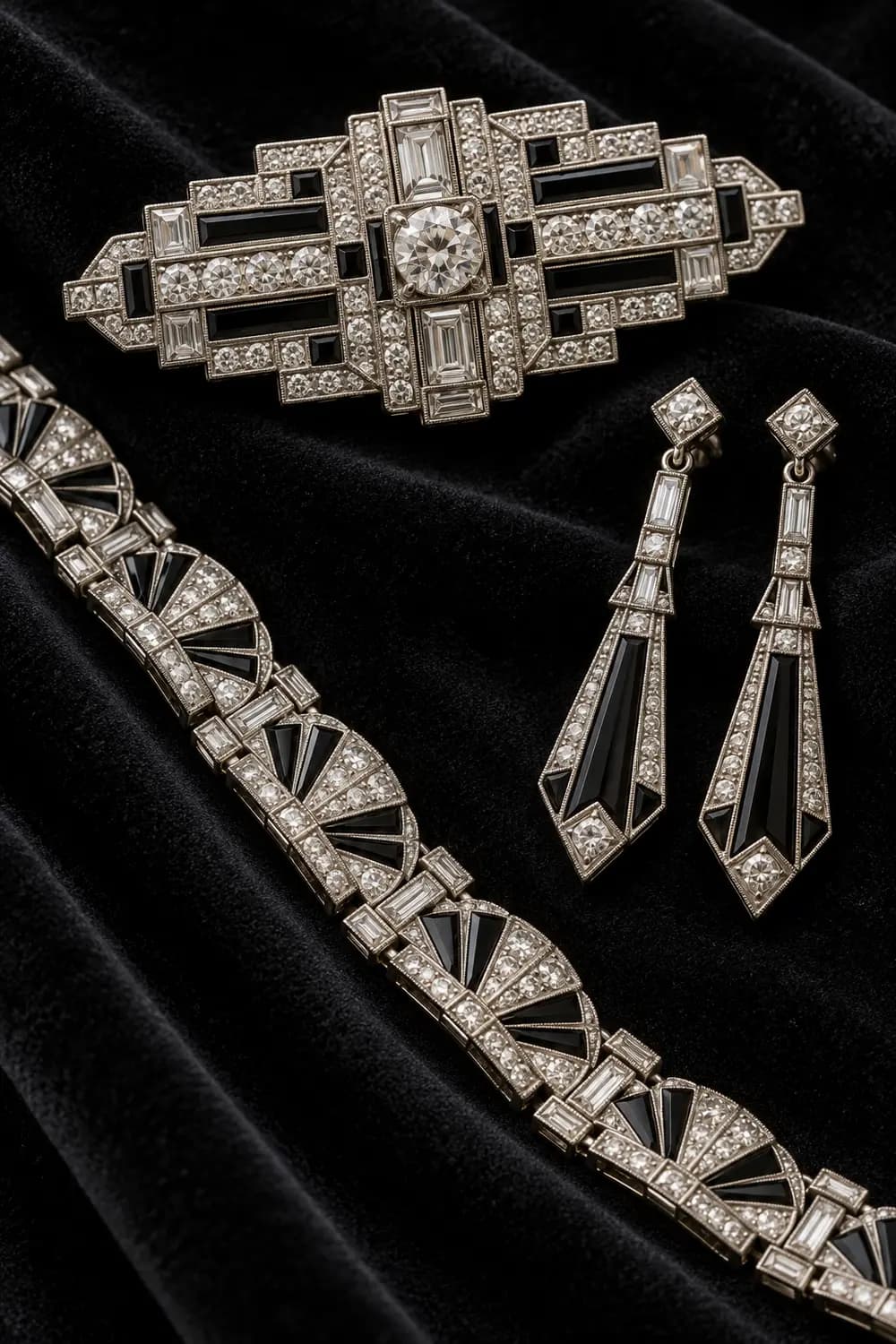
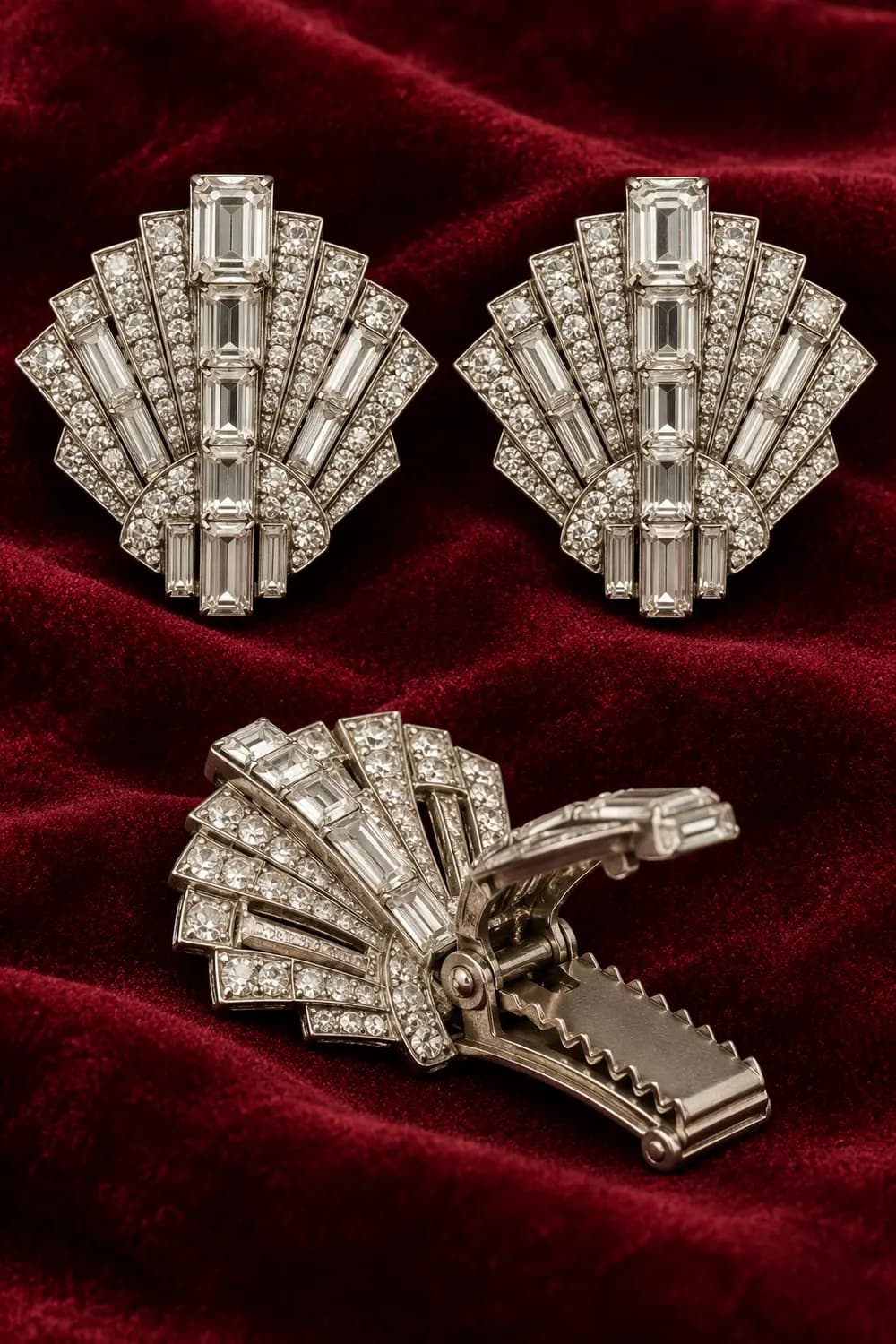
Art Deco often starts with the opposite instinct: give the object a firm shape and arrange its details inside it. Look for stepped edges, parallel bars, fans, chevrons and repeated rectangles. It is a useful comparison, not an iron rule. The V&A notes that Art Deco absorbed some Art Nouveau motifs, while GIA describes a much wider range of Art Deco designs than strict black-and-white geometry.
A quick exercise: cover the stones with your thumb and look only at the metal outline. Does the outline feel like a leaf or wing in motion, or like a carefully designed facade? You are describing its visual language, not dating the piece.
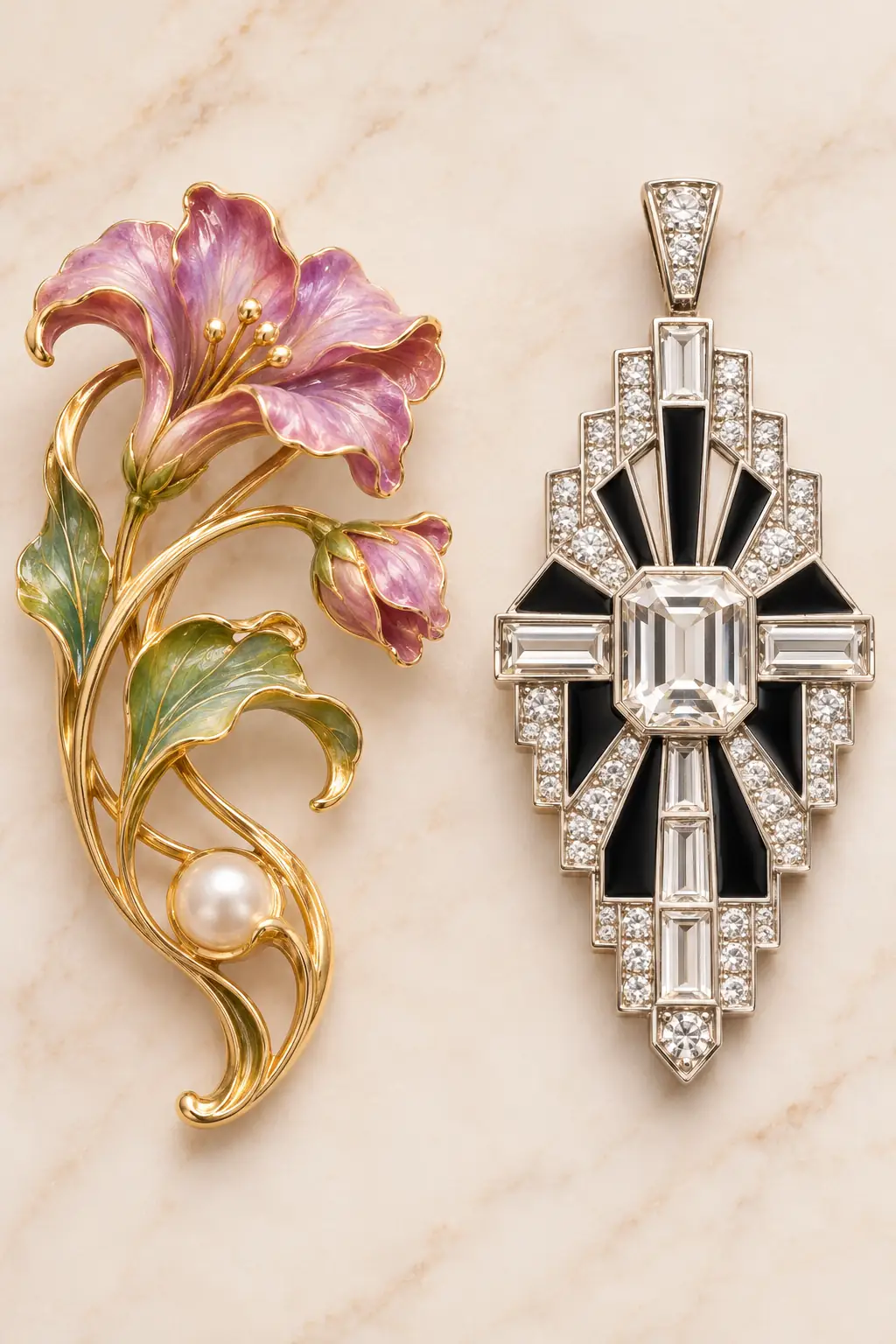
Two newly created jewellery designs illustrate the difference between flowing natural forms and stepped symmetry, rather than dating a real antique.
2. Nature appears in both styles, but it changes character
Dragonflies, orchids, butterflies and flowing hair are closely associated with Art Nouveau. The interesting part is the treatment. A wing may dissolve into enamel; a flower might seem to twist, wilt or open. Jewellery by René Lalique and Philippe Wolfers shows how far makers pushed these effects, sometimes making the material more important than the value of a gemstone.
Art Deco did not suddenly abandon flowers. Early Deco pieces could have stylised bouquets, fruit baskets and foliage. But their flowers often sit in a deliberate border or repeat as a pattern. GIA's account of the period includes floral and Egyptian-derived motifs alongside geometric designs.
This is why a single dragonfly does not identify a piece. A modern designer can make a dragonfly brooch tomorrow. The question is how the insect is drawn, how the materials are worked and what the physical object tells you.
3. Enamel can tell you more than the colour
Art Nouveau makers made remarkable use of enamel, sometimes over surfaces that seem almost impossible to control. Plique-à-jour enamel, with translucent colour and no solid metal backing behind the coloured cell, lets light through in a way that resembles miniature stained glass. The V&A's discussion of Wolfers' orchid ornament is a good place to see why technique mattered so much.
A bright, translucent wing is an interesting clue, but not an automatic period signature. Enamelling techniques have been used across periods, and repaired or contemporary work can appear convincing in photographs. A seller's use of the words 'plique-à-jour' should be checked against close views of the object.
If you are examining a real jewel, ask for a clear photograph with light behind the enamel as well as one showing its reverse. Do not push, bend or scratch an uncertain antique to test it.
4. Art Deco treats contrast like architecture
Think of white stones beside black onyx, a row of baguettes beside a square centre stone, or emerald colour bounded by platinum-white metal. Those are familiar Art Deco arrangements because contrast helps define the shape. The diamonds are not simply decoration; their setting can draw a border, a step or a repeated rhythm.
Art Nouveau jewellery could also use striking colours, but its effect often comes from blended surfaces, unusual material combinations or a dramatic figurative shape rather than a grid of stones. Lalique was especially willing to use glass and horn where conventional fine jewellery favoured expensive gems.
There is no safe shortcut based on precious metal. White gold, platinum and silver can appear in later pieces, and a golden colour does not exclude either style. Colour and metal are clues to ask about, not proof.
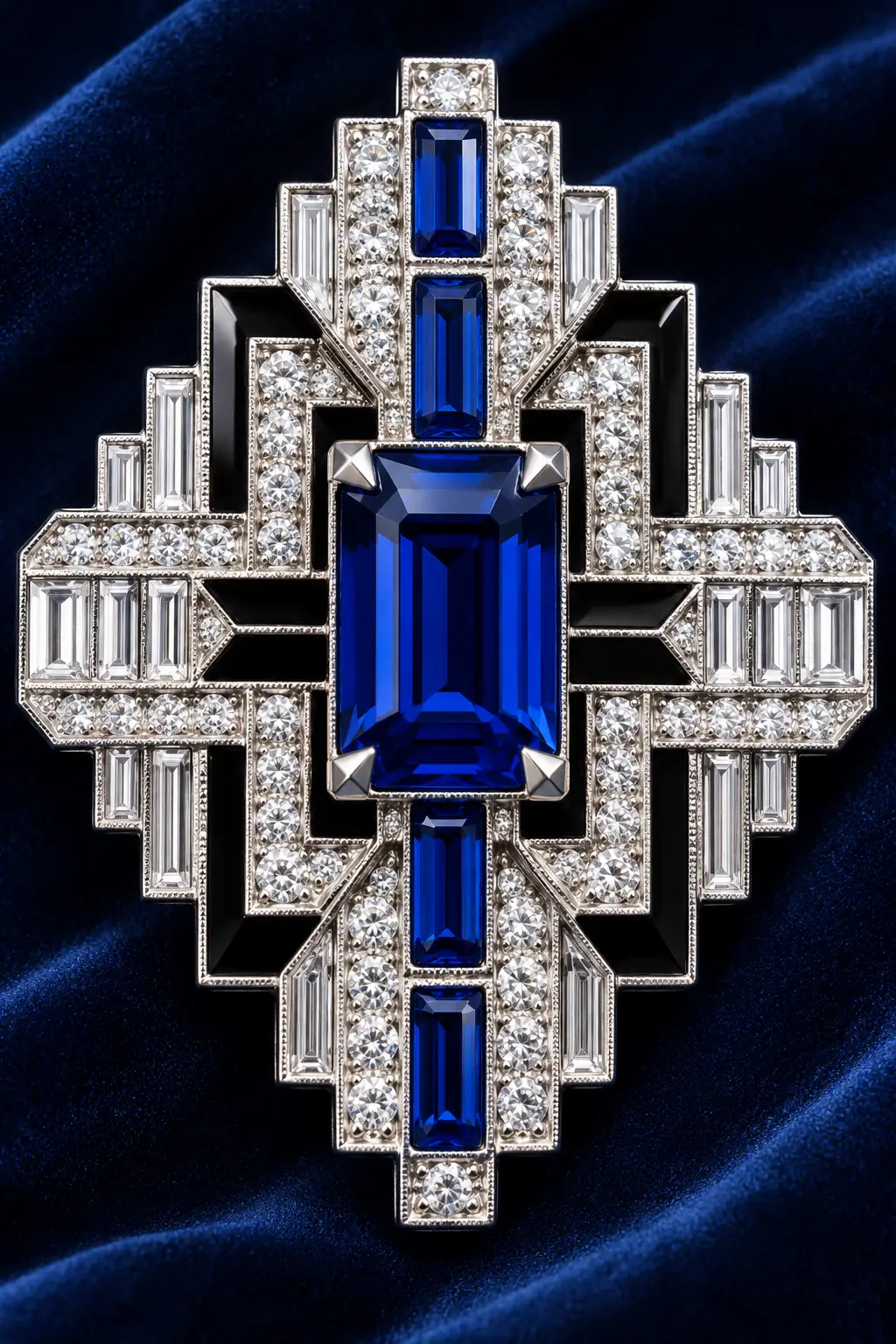
A newly created geometric brooch illustrating strong contrast and repeated architectural lines; it is not an authenticated period jewel.
5. The dates overlap less neatly than auction descriptions suggest
The V&A places Art Nouveau jewellery's high point around 1895–1910, while Art Deco became especially visible in the 1920s and 1930s. But artistic change does not happen on a single New Year's Day. Makers worked across movements, clients kept wearing older styles, and some designs were later revived.
Art Deco itself changed. GIA distinguishes relatively graceful early examples from the more severe geometry associated with later work. And the V&A points out that Art Deco borrowed from linear Art Nouveau. Not everything produced in the 1920s was Art Deco, just as not every curving brooch was made in 1900.
When an online listing says 'Art Nouveau era' or '1930s Art Deco', separate the style description from the claimed production date. The latter ought to have supporting evidence.
6. The reverse is often more useful than the front
Turn an object over, or request sharp photographs of its reverse. Look at the clasp, pin stem, joints, solder, settings and any small stamped marks. Has the fastening been replaced? Does the back look consistent with the rest of the object? Is there an unexplained repair? A beautiful front view can hide all of these questions.
Do not use a single clasp design as a precise dating chart. Fastenings can be repaired, replaced or copied. The better approach is to combine what you see on the back with marks, documented maker patterns, proven ownership and appropriate expert examination.
For an expensive purchase, ask for front-and-back images taken in natural light, plus close-ups of any maker or metal marks. If a seller cannot provide them, that limitation matters more than how persuasive the period description sounds.
7. Try a three-column comparison rather than a label
Write down three observations before naming the style. First, the silhouette: flowing, balanced, stepped, angular or figurative. Second, the decoration: naturalistic flower, stylised fan, repeating stones, translucent enamel. Third, the construction: hinge, pin, marks, repairs and setting. Only then compare the results with well-documented museum examples.
For instance, a brooch might have a curling orchid outline, enamel wings and an apparently modern replacement clasp. 'Art Nouveau-inspired botanical brooch; age unconfirmed' would be a more useful description than 'genuine 1900 Lalique' based solely on its shape.
Likewise, a symmetrical fan covered in black and clear stones could be described as Art Deco-style without asserting that its stones, metal or manufacture date have been verified.
8. Where to look at actual period examples
Start with the V&A's jewellery history and its Art Nouveau collection feature. The museum documents René Lalique, Philippe Wolfers, their materials and particular surviving objects. For Art Deco, compare the V&A's fashion and design material with GIA's historical jewellery research.
Spend a minute with the object captions, not just the photographs. Museum records often tell you the maker, approximate date, country and materials. Those details let you see how real examples compare without treating a modern illustration or a resale listing as provenance.
If you are buying, collecting or inheriting a piece, the most responsible conclusion may be that it is beautifully styled and still unidentified. That is a better beginning for research than an attractive but invented date.